

The Days of the Last Day
When I graduated from my final year of school, I had four last days. One was the last day that I had classes: my last school day of learning. Another was the day of my final exam: my last academic responsibility. Another was my graduation day: when it was publicly recognised in the school community that my school days were over. And another was the last day I was physically at school as a student: where the school held a guard of honour, after which I walked out of the school grounds and was no longer a student. But which was my actual last day? In the months leading up to my graduation I was looking forward to my last day, and every aspect of these different days, but it wasn’t until I was graduating that I realised that my last day was actually many last days. And I believe that this discrepancy between the expectation of and the actual realisation of the last day is a helpful when we consider what the Bible has to say about The Last Day.
Prior to Jesus’ death, The Last Day goes by a few different names; ‘the last day’ (Jn. 11:24), ‘the Day of the Lord’ (Am. 5:18-20), ‘that day’ (Zec. 9:16), ‘the latter days’ (Mic. 4:1), or ‘the day/s’ (Jer. 31:31). And as the biblical evidence mounts throughout the Old Testament, the exact nature of this Day crystallises more and more. It is a day of many expectations; judgement against Israel (Is. 2:12), judgement against the nations (Joel 3:9-21), salvation of Israel (Mal. 4) and the nations (Zep. 3:9-13), security, justice, peace (Mic. 4:3-4) and the personal coming of God to institute His kingdom on earth (Zec. 14:1-9). Succinctly put, it is a day when the opponents of God will be defeated as He re-establishes His rule (Is. 2:1-5).
Immediately after Jesus’ ascension, His future return is promised (Acts 1:11). And as the New Testament will flesh out, at the time of His return, all these expectations for the Day of the Lord will become a reality. Jesus’ second coming will completely unite all things under His rule (Eph. 1:15-23), establish God’s eternal kingdom and destroy death (1 Cor. 15:24-28) and will be a day of judgement through which the new creation will be ushered in (2 Pet 3:13). Perhaps most significantly though, it will be a day of resurrection when all will be raised (Jn. 5:29); unbelievers into judgement, and believers with a new Spirit-enpowered body into the kingdom of God (1 Cor. 12). What an exciting future!
However, as we read through Jesus’ ministry and the rest of the New Testament more carefully, it quickly becomes evident that the Day of the Lord is not just a future hope, but a present reality. And like my schooling experience, the Last Day is not so much a single day in time, but actually many last days. And to merely think of the Last Day as Jesus’ second coming is too simplistic. In a somewhat complicated sense, the Last Day has already been, we are currently living in the Last Day and we are still waiting for the Last Day, all at the same time. When was the Last Day? Well… in the first instance, the day Jesus was killed on the cross[1]. When was the day of judgement against Israel and the nations? When was the day of salvation? When was God’s rule established and His kingdom instituted? Well, in Jesus’ death, resurrection and ascension! Jesus’ crucifixion is not merely Jesus paying for the sins of all people but is actually the Last Day. The end is not only nigh, the end has already arrived. In Jesus’ death, the end of the world has come. The cross is not just a significant event in history, but defines history. This cataclysmic event has ushered in the new age of God’s kingdom and rule.
However, despite the inauguration of the God’s new age, the old age is not yet done with. While sin is defeated, it is not yet destroyed. While we have been spiritually raised to life, we still physically die. While Jesus is Lord, the world still rejects Him. Like a tube that when viewed face-on appears as a circle, and not until you enter into it do you realise it has depth, similarly it is not until we pass through Jesus’ death and resurrection that we realise the Last Day is actually many Last Days. The end has begun but is not yet fully over. Commonly this period in history is referred to as ‘the Overlap of the Ages’, ‘the Last Days’ or ‘the Now and Not Yet’.
This delay in the final day, however, is not a reason to despair, but a reason to rejoice. First and foremostly because as inevitably as the fall of the first domino ensures the fall of the last, so too does the coming of the ‘first’ Last Day ensure the coming of the end. Secondly, because every day of delay by God is another day of mercy towards the unrepentant, and an opportunity to escape the judgement to come (2 Pet 3:9). And finally, because this has a myriad of profound implications for our lives now with the outpouring of blessings that accompany the Last Day. For believers, judgement for sin is fully achieved on the cross (Rom. 5), we are no longer enslaved to sin (Rom. 6:15-23), we can live lives of holiness (Eph. 4:1-5:21), we are guaranteed of inheriting the kingdom by the Holy Spirit (Eph. 1:14) and much more besides. And most significantly, Jesus is currently reigning as king (Acts 2:22-36). We are living anno domini (AD), in the Year of our Lord.
[1] Peter Bolt’s ‘The Cross from a Distance’ is immensely helpful in fleshing this out, particularly in its third chapter: ‘The Cross as ‘The End of the World’’. Although I would recommend reading the entire book.

Grumbling & Complaining
I don’t know about you, but I really enjoy coming across confusing or tricky passages in Scripture. I enjoy wrestling with them, tossing them over, discussing them in Growth Groups, and working hard to understand them. I find it incredibly rewarding to learn something new about God’s character and re-evaluate what I had previously misunderstood. Scripture is full of many such passages. Philippians 2:14; however, is not one. ‘Do all things without grumbling or disputing’.
What a simple command! There’s no tricky exegesis or complex theology. It’s easy to rush over it. But we shouldn’t! Though simple, what an incredibly difficult command! I’ve been mulling over this verse recently and have again been reminded of how we constantly need God’s word to define our attitude. Think about it: Does Paul really mean ‘all things’? No grumbling, no complaining, at all?! That’s a big ask! How starkly this stands in contrast to our world where grumbling against our bosses is a right and complaining in lunchrooms about whoever isn’t there is commonplace. It’s almost a way of life. But if we pay attention to our history, it becomes readily apparent that there is perhaps nothing quite as dangerous as grumbling.
The paradigmatic grumblers are the Israelites in the wilderness. Having been rescued out of Egypt by a mighty display of God’s power over Pharaoh, having walked between two walls of water along a dry seabed, having received His gracious law, separating them as His special nation and having been sustained for two years by bread that literally came down from heaven… the people of Israel had the audacity to complain about the lack of cucumbers. “Oh that we had meat to eat! We remember the fish we ate in Egypt that cost nothing, the cucumbers, the melons, the leeks, the onions, and the garlic. But now our strength is dried up, and there is nothing at all but this manna to look at.” (Num. 11:4-6) What an outrageous comment! Yes, they might have had fish and melons and cucumbers in Egypt. But what else did they have? Impossible brick-making quotas, subjugation, beatings and the death of their sons (Ex 1, 5). Yet conveniently, this seems quickly forgotten by the Israelites while in the wilderness. But you see, this is what grumbling is characterised by. A false memory. Perhaps sometimes a biased or a short memory. But a memory that fails to remember reality, God’s actions and His promises.
Think back to Exodus 15. One of the first things that the Israelites did after crossing through the Red Sea was grumble. They complained because of the lack of water (Ex. 15:24) and food (Ex. 16:2-3). Yet each time, God was gracious and provided for them. Well, then in chapter 17, having seen God’s power to provide food and water, and knowing his promise to take them into Canaan, when there is no water in the wilderness they grumble once again against Moses and God. And famously, God once again provides water for them through the striking of the rock, and Moses ‘called the name of the place Massah (testing) and Meribah (quarrelling), because of the quarrelling of the people of Israel, and because they tested the LORD by saying, “Is the LORD among us or not?”’ (Ex. 17:7)
Now, we might be tempted to ask what the issue with a little grumbling is? After all, they were travelling through the wilderness on foot. Surely they were parched, how serious can some venting be? Well, as Psalm 95 tells us, extremely serious. ‘Today, if you hear his voice, do not harden your hearts, as at Meribah, as on the day at Massah in the wilderness, when your fathers put me to the test and put me to the proof, though they had seen my work. For forty years I loathed that generation and said, “They are a people who go astray in their heart, and they have not known my ways.” Therefore I swore in my wrath, “They shall not enter my rest.”’ (Ps. 95:7-11) Do you see the danger? Israel’s consistent grumbling against God, despite his ongoing faithfulness, is what kept them out of the Promised Land. And not only that, but also the final and eternal Sabbath Day rest (Heb. 4:1-10). You see, grumbling is something that we as Christians cannot afford to do. Each grumble and complaint is like another layer of lacquer that builds up on our hearts, slowly but surely hardening them against the goodness of God and His word. Complaining is not a chance for us to vent our frustrations; it has the potential to lead us astray from God and from His eternal rest.
So friends, what can be done? Well, fortunately God is gracious. Because if grumbling is characterised by a false memory, then the solution is true remembrance. And if complaining causes us to forget, then thanksgiving reminds us of reality. Listen to the start of Psalm 95. ‘Oh come, let us sing to the LORD; let us make a joyful noise to the rock of our salvation! Let us come into his presence with thanksgiving; let us make a joyful noise to him with songs of praise! For the LORD is a great God, and a great King above all gods.’ (Psalm 95:1-3) The path from grumbling to joyfulness runs straight through thanksgiving. And this is no band-aid solution, trying to see the silver lining in every situation. No, this is a true remembrance of what God has done for us. Thankfulness that despite how difficult our situation may be, we remain as God’s chosen people. Thankfulness for the beauty of his creation and all of his good gifts to us. Thankfulness that he has rescued us from that which we could not rescue ourselves and has given us new life forever. We must heed the warning of Meribah and Massah and not grumble against God, not hardening our hearts to His word. For He is a great God, and a great King above all gods. ‘But be filled with the Spirit, addressing one another in psalms and hymns and spiritual songs, singing and making melody to the Lord with your heart, giving thanks always and for everything to God the Father in the name of our Lord Jesus Christ.’ (Eph. 4:20)

Friendship versus Contact Evangelism
“Friendship Evangelism” is the idea that before we share the gospel with an unbeliever, we need to develop a close relationship with them and become friends. I don’t believe in Friendship Evangelism.
Firstly, and most importantly, it’s not biblical. In the bible, you don’t see Jesus or his apostles doing this kind of thing - sidling up to workmates, getting to know them over six months, connecting over hobbies and shared values, “earning the right to speak into their lives” etc. only to get to the gospel eventually. No, wherever they went, Jesus and his apostles brought up the gospel quickly and spoke with boldness.
Moreover, Friendship Evangelism contradicts key biblical doctrines. For instance, the idea above that you need to earn the right to evangelise, directly denies the gospel itself – which is about the universal Lordship of Jesus. Jesus is actually the primary evangelist, preaching his gospel through us. He is announcing to the world that he is their rightful Lord (Acts 10:36). Whether we/they feel he has the right to say such a thing or not is irrelevant – God has set his King on his throne and commands all people everywhere to repent before the amnesty period is over (Acts 17:30-31).
Likewise, Friendship Evangelism undermines the doctrine of election. It is God’s choice, who he saves. Not our choice. As hard as this may be to hear, it’s not that you can just pick your friend or family member and say, “I choose so and so to be saved, and I’m just going to make sure that they are saved by deepening my friendship with them and then tactfully evangelising them over the next thirty years”. No, that’s not your prerogative. In fact, it’s arrogant. God gets to choose who he saves, and our job is to preach the gospel far and wide to everyone, so that the gospel draws out the people he has chosen. Someone once described evangelism as mining for gold in a hill. We know that God has chosen people out there who he intends to save. Our job is to go out and find those people by preaching the gospel. If I can develop that illustration a little bit further, the gospel is like a big metal detector. As you preach it, sooner or later the elect will be ‘exposed’ as they respond in faith. Our job is not just to select one patch of ground, hold the metal detector over it relentlessly until somehow the dirt turns to gold. No that’s not how it works. Our job is to keep waving the metal detector everywhere – i.e. preaching the gospel to everybody.
The second reason why I don’t believe in Friendship Evangelism is that it’s insincere. You can’t get to know someone for six months or whatever, claim to be their friend, while keeping the gospel and your Christian faith under wraps or even in the background. If Jesus is the most important person in the world to you, then how can someone really know you unless they know what dominates your life and thought. Likewise, when you finally tell them that the gospel is the most wonderful news, and you want everyone to hear it, and it’s super urgent that people do hear it, because Jesus could be coming back any minute to judge us all… how do you think they’re going to respond? Surely, they’ll say to you, “If you really believed that… you would have told me ages ago! And if you were really my friend, you wouldn’t have been playing fast and loose with my salvation.” Thus, the method, completely undermines the message.
Thirdly and finally, it’s impractical. Number 1 - because you can only have so many close relationships, can’t you? Once you’ve got 3 or 4 close friends, you start to run out of space for more. And Number 2 – because it actually becomes harder and harder to share the gospel with people the closer you get to them. So don’t get me wrong, if you have a non-Christian friend – then please share the gospel with them. But my guess is that once you do that a few times, it’s just going to become harder and harder to do it again. If they’re not interested, at some point you can’t keep shoving the gospel down their throat, can you? It’s the same with family members, and maybe your neighbours – all these long-term relationships. Once you’ve shared the gospel with someone, and they’re not interested, it’s increasingly difficult to do so.
Now, just as an aside, when it comes to your long-term relationships, my suggestion is that once you have shared the gospel with them, and they’re not interested… stop trying. Of course, I don’t necessarily mean straight away – you can try a few times if you like. And I think ‘dropping bait’ in conversation is a good idea – like, every now and again offering them opportunities to talk about Jesus or forgiveness or life and death if they want to. But not being too worried if they don’t bite. And if they ask you about your weekend or for some opinion – don’t filter out your Christianity – presumably, as your friend, they will want to hear about what’s important to you. But if you’ve got to the stage in your relationship where they’ve come to church, you’ve explained the gospel quite fully to them, and they’re still not interested, or they’ve asked you not to keep bringing it up, my advice is… don’t. Instead, tell them you’d always love to talk to them about God if they ever change their mind. If they ever want to read the bible with someone, you’d love to do that with them. Something to the effect of, “The door’s always open!” Then hope and pray, that as life goes on, maybe a crisis or something else will happen in their life, and they’ll realise they want to talk to someone about God. And at that point, you’re hoping they’ll think of you as their ‘God-Person’. You know, when they lose their job, or get seriously sick, maybe all of a sudden they’ll want to talk about the afterlife. At that point, you want to make sure that they think of you, and that they know the door’s still wide open. But remember this is a strategy for a few particular people in your life. It is not the bible’s strategy for spreading the gospel far and wide across the whole world!
Instead, the bible encourages us to do what I would call Contact Evangelism – that is, constant gospelling of many different contacts who come in and out of our lives. As we’ve been seeing in the book of Acts, the key word for evangelism is boldness. It means to be upfront, public, open, honest. Your job is to be friendly and warm and loving and kind and gentle and gracious with everyone you meet. Wave and smile at everyone. And be enthusiastic about the gospel! Try to make sure that everyone you know, knows that you’re a Christian, and that you’d love to tell them about the Lord Jesus. Ask people, “Do you know about the Lord Jesus? Have you heard about Jesus’ resurrection?” “Oh! You really should come to my church some time!” “Yeah, let’s chat about it after work… I’ll shout you a coffee.”
George Whitefield (1714-1770), by far the most effective Evangelist of the English-speaking world, made it a rule never to have a conversation for more than 15 minutes without bringing up the gospel. The gospel is the kind of thing you can bring up with strangers - share it on the bus, on a train or a plane, share it at work, on a sports team or wherever. As a rough guide to get started, here are a few tips:
1. Pray daily for opportunities to meet new people and boldness to share the gospel with them.
2. Find a place where you meet lots of people – a revolving door kind of situation. Your workplace might work like this, but alternatively you could join a sports team or another club.
3. Try to strike up friendly conversations where you naturally, openly, and enthusiastically talk about Jesus and how much he means to you. Ask people if they know much about Jesus.
4. Be resource ready. Always carry TWTLs in your bag, and a few copies of the Essential Jesus.
5. Steel yourself for rejection. My sister likes to ask people to read the bible with her. She once told me that generally 1 out of every 6 or 7 women will say yes to her invitation. So she just needs to brace herself for the 5 or 6 rejections and hold out hope for that one.
6. Practice makes progress. Even if someone does reject you, or a conversation doesn’t go great – each new stranger gives you a fresh start and (maybe) a chance to learn from your mistakes.

How God the Son became the Son of God
“God the Son” is not a phrase that appears in the bible. Rather, like the word “Trinity”, it is a systematic summary of what the bible teaches. It refers to the second person of the Trinity who is truly God – eternal, infinite, of one essence with the Father, the creator of all things, the Word who became flesh and dwelt among us in the person of Jesus.
By contrast, the title “the Son of God” appears frequently in the bible. But this title does not always apply to God the Son. In fact, in the first place, it is a human title. This is what it means to be made in God’s image (Gn. 1:26-27). Adam was the Son of God (Lk. 3:38) and all his descendants likewise are God’s sons (Lk. 3:23-38). See, for instance, Gn. 5:1-3 where the connection between Image bearing and Sonship is clarified…
This is the book of the generations of Adam. When God created man, he made him in the likeness of God. Male and female he created them, and he blessed them and named them Man when they were created. When Adam had lived 130 years, he fathered a son in his own likeness, after his image, and named him Seth. (Gn. 5:1-3)
As God’s children we are to have dominion over the universe (Gn. 1:28). Plants, rocks, etc. are part of the furniture, if you like, dolphins and elephants are precious pets in the household, but humans alone are God’s children. We are God’s offspring (Ac. 17:28-29). Even after the fall, this remains true – our fundamental nature has not changed. This is why an attack on a human being is such a serious offence (Gn. 9:6). For an attack on God’s image bearers is in some sense an attack on God himself.
What has changed of course, is that human beings no longer live worthy of their special status as God’s image bearers. We are wayward children, prodigal sons. Children are supposed to honour and obey their parents (Ex. 20:12, Mal. 1:6, Prov. 10:1, Eph. 6:1-3), and gratefully receive their fathers’ gifts (Mat. 7:11, Jam. 1:17, 1 Tim. 4:4). Because of our wicked behaviour, God’s judgement upon us (partially experienced now) may be described as a sort of disowning or disinheritance. This is what Adam and Eve experienced when they were banished from the garden. God will not let us live long on his land, so long as we insist on dishonouring him and trashing his property.
In the book of Exodus it becomes clear that God is determined to adopt a new Son from within the human race; the nation of Israel. The LORD tells Moses,
Then you shall say to Pharaoh, ‘Thus says the LORD, Israel is my firstborn son, and I say to you, “Let my son go that he may serve me. If you refuse to let him go, behold, I will kill your firstborn son.”’ (Ex. 3:22-23)
Pharoah, of course, refuses to let God’s firstborn son go, until his own firstborn Son is killed (Ex. 12:29-32). In this way, God rescues his Son from slavery (Hos. 11:1) and delivers them to a new inheritance – the land of Canaan (Deut. 4:21).
Then within the nation of Israel, the theme of sonship focuses down one more time. God specially selects David, the King of Israel, promising him that his son will be the Son of God.
I will be to him a father, and he shall be to me a son. When he commits iniquity, I will discipline him with the rod of men, with the stripes of the sons of men, but my steadfast love will not depart from him, as I took it from Saul, whom I put away from before you. (2 Sam. 7:12-15)
We are often tempted to apply this passage straight to the Lord Jesus. But it is worth slowing down for a moment (especially when you read v.14b) to realise that God is talking about all of David’s kingly line. Solomon will be the first Son of God from David’s line, then Rehoboam and so on. As soon as the King is crowned, he has become the Son of God. This is what is meant in Psalm 2, when the King of Zion recounts what the LORD said to him at his coronation, “You are my Son; today I have begotten you.” (Ps. 2:7).
By the time we arrive in the New Testament then, and Jesus is called the Son of God (Mk. 1:1, Lk. 2:49 etc.), first and foremost we ought to have these three categories in mind – Jesus is the new Adam (Lk. 3:38, see also 1 Cor. 15:45), the new Israel (Matt. 2:15), and the new Davidic King (Lk. 1:32-33). Jesus succeeded in trusting and obeying his Father where all the sons of God failed before him (see esp. the temptation in the wilderness (Lk. 4:1-13)). This is why Jesus is the beloved Son with whom the Father is well pleased (Lk. 3:21-22). Historians will tell us as well, that Jesus’ sonship is a direct affront on the claims of the Roman emperors who also called themselves sons of god (Lk. 2:1).
What is surprising, of course, is that Jesus is also God the Son (Mat. 1:23, Jn. 1:1, 14 etc.). And one of the great delights of the New Testament is to point out the ‘fittingness’ of all this – that God the Son became the Son of God. Or perhaps to use more biblical language - the true, unique, original Son of God became the human Son of God, the first among many sons. See for instance the language of Fatherhood, Sonship and Brotherhood in Colossians 1.
Timothy and the gentile Christians at Colossae are brothers and God is our Father (vv.1-2).
God is our Father because he is particularly the Father of the Lord Jesus Christ (v.3).
The Father has qualified us to share in the inheritance of the saints (i.e. the Jewish Christians), having transferred us into the Kingdom of his beloved Son (vv.12-13). The language here (e.g. redemption) is particularly reminiscent of the Exodus narrative concerning the nation of Israel.
Finally, Jesus is the image of the invisible God, the firstborn of all creation (v.15). The language here is particularly reminiscent of Adam.
But… why is Jesus deserving of such a glorious position? Why is it fitting that he is the heir of the world?
For by him all things were created, in heaven and on earth, visible and invisible, whether thrones or dominions or rulers or authorities—all things were created through him and for him. And he is before all things, and in him all things hold together. (Col. 1:16-17)
Ah, of course! Jesus deserves to be the ruler of the world, because he made the world. Jesus is the perfect Son of God because he was always God the Son. We were made to bear the image of the Image of the invisible God (1 Cor. 15:49). We were made sons of God by the Son of God twice over (Lk. 6:35, Jn. 1:12, Heb. 2:10-18) – first in our creation from dust and then again through the resurrection (Jn. 3:3, 1 Pet. 1:3)! That is why he deserves absolute pre-eminence in both this world and the next (Col. 1:18, Heb. 2:5)!

Proverbs: A Jungle Gym for your mind
I love the book of Proverbs. There are seven collections within the book. The first collection goes from chapters 1-9 and acts as an introduction to the rest.The main point of the introduction is to persuade us of the great value of wisdom.
7 The beginning of wisdom is this: Get wisdom,
and whatever you get, get insight.
8 Prize her highly, and she will exalt you;
she will honour you if you embrace her.
9 She will place on your head a graceful garland;
she will bestow on you a beautiful crown.”
(Prov. 4:7-9)
Wisdom is skill for living. It involves understanding the world that we live in and being able to act accordingly. In the book of Exodus, for instance, it’s all the skilled craftsman who make Aaron’s garments and decorate the tabernacle, who are said to be filled with God’s Spirit and with wisdom. Likewise, a master musician, or a skilled sportsman could be described as wise in their respective fields – because they both understand their craft and are able to execute proficiently.
But of course, the book of Proverbs is not primarily about helping us nail woodwork, master an instrument or succeed in sport. It’s about teaching us how to live the whole of our lives skilfully. It’s designed to make us wise for salvation (2 Timothy 3:15) by showing us not only how the world works – what the rules are etc. – but even more importantly who the ruler is, and how we can craft a life that is significant and worthy and beautiful in his sight. Hence,
7 The fear of the LORD is the beginning of knowledge;
fools despise wisdom and instruction.
(Prov. 1:7)
Now, the first nine chapters of Proverbs are a relatively straightforward, easy read. The argument seems to flow logically and coherently. Then in chapter 10 it’s as if we are thrown into the jungle. Suddenly, proverbs are flying at us thick and fast - on all manner of subjects. There seems to be no coherence to the material or connections between the sayings. At first, this can be a rather daunting and exhausting experience. If your bible’s anything like mine, you’ll notice that the publishers usually give up at this point and stop putting in headings. But this is where we see the real genius of the book. I call it the ‘Jungle Gym’ approach. And the proverbs are arranged in this way I think for at least three reasons:
First, because it deliberately excludes fools. The book of proverbs is self-consciously not for everyone. It’s for the wise to help them increase their knowledge, and it’s for the simple/youth to help them learn prudence etc. but it’s not for fools – for in their arrogance they will never learn (Prov. 1:1-7). So while chapters 1-9 are simple and accessible to everyone, in chapter 10 the fools are weeded out. The increased difficulty here will whittle down the readers to those who really believe in the value of wisdom. For those who remain unpersuaded by the previous chapters (i.e. the fools), this is the point at which they will check out. Like parables, Proverbs are designed deliberately to exclude such people (cf. Mark 4:10-12). They refuse to reward the lazy sluggard. In this way, the book of proverbs is a bit like a gym. The value of a gym is clear for all to see from the outside, but in the end, it’s only the people who put in the hard work who will get the reward.
Moreover (secondly) it is precisely the hardness of the work that makes the gym effective. For our muscles to grow and strengthen, we need to push them through resistance and struggle. Just so, the book of Proverbs is designed like a gym for the mind. It’s meant to be tough. You’re meant to put your back into it. You’re meant to struggle and strain through the complexity because you know the great prize that awaits you.
In particular, it is the complex arrangement of the book that makes it so difficult – rather than the individual proverbs themselves. Imagine, for instance, if it had all been arranged simply - one topic after another (as it is often preached). This would be like removing the weights from a gym and still expecting people to grow strong. They wouldn’t. The point is that you can’t “get wisdom” in three easy steps. A simple arrangement would only perpetuate simplistic thinking. That’s why it’s not a simple book, it’s a complex book, that forces us to learn wisdom by its very arrangement. It teaches us patience, discernment, hard work, good listening, careful thinking, precisely as we engage in its complexity.
Thirdly, of course the gym is meant to prepare us for the world. And the book of proverbs reflects how the world is. It’s a jungle out there! The world is a complex ecosystem. It’s not simple or neat – like an excel spreadsheet or a machine, it’s complicated and organic like a rainforest or the human body. Each part of the ecosystem feeds into and effects another part. It can look messy, but that doesn’t mean it’s not ordered, or that the arrangement doesn’t matter. You might not know how algae effects gorilla numbers, or how lies and lust and laziness are all connected but they are. And wisdom is to be found in knowing the connections. Knowing what will happen if you turn this knob or pull that lever. For instance, did you know that the Sahara Desert is essential for all the life in the Amazon Rainforest? Up until a few years ago, I would not have thought that the two places were connected at all. I mean they could not be more different - Life and Death, Rain and Drought. You couldn’t get two more different environments. They’re on two different continents, thousands of miles of away from each other. But apparently – all credit to the kind folks at NASA who enlightened me on this – each year the strong winds in the Sahara Desert pick up millions of tons of dust, carry it across the Atlantic Ocean and dump it on the Amazon basin, fertilizing the whole rainforest with nutrients. Who would have thought?
And just as we inhabit a physical ecosystem, we also inhabit a moral and social and spiritual ecosystem – with hidden connections to be found there as well. The reason our world is in such a mess, is because having rejected God, we no longer have the wisdom required to rule his world – the environment, the economy etc. We know there is an orderliness to the creation, that can be mapped with mathematical precision and taxonomy and ecology, but as long as we keep on resisting God’s revelation, our sin and his judgment will continue to frustrate our understanding of it.
The book of proverbs is designed to show us the intricacies of God’s good design, and the connections that underpin the moral and relational structure of his world. Just like a jungle there is a hidden orderliness behind the apparent chaos. The proverbs have been carefully arranged and are deeply connected – usually by catchwords, bookends and otherpatterns of repetition. The job of the reader is to patiently study these patterns (like a good botanist!) and discern the hidden connections. This will take lots of hard work, but in the process of learning about the book, we will also be learning about the world the book is designed to reflect. We will find God’s word (through both its message and medium) shaping the way we perceive and understand God’s world. So next time you read through the book of Proverbs, ask yourself, not just what does this or that particular proverb mean? But also, why have the proverbs been placed in this arrangement and what does that teach me about the way God’s world is arranged?

God opposes the proud…
“God opposes the proud but gives grace to the humble.” This quotation, originally taken from the Greek translation of Proverbs 3:34, appears twice in the New Testament - in James 4:6 and in 1 Peter 5:5. It is a classic example of Hebrew parallelism. There are two halves to the proverb set in contrast to one another. God is the actor in both scenarios. He acts in two very different ways in response to two very different kinds of people.
In this essay, I want to tease out the differences between pride and humility and God’s responses to each. Pride has to do with thinking more highly of yourself than you ought (Rom. 12:3), being puffed up, self-sufficient, and contemptuous of others. In Romans 1:30 and 2 Timothy 3:2 it is listed alongside other sins such as being insolent, boastful, lovers of self, lovers of money, abusive (or blasphemous) and disobedient to parents. It stems from a rejection of God and the good hierarchy he has built into his creation. The proud person rejects the idea of living in their station and playing their part. They cannot abide submitting to the authorities God has placed over them – whether in the church, the family or the nation. They will not offer themselves in loving service to others for they are so in love with themselves. So they exalt themselves and exert their power.
By contrast, humility has to do with embracing a lowly, small and obscure life. The humble, are not concerned for their own status or esteem because they are so genuinely concerned for the glory of God and the welfare of others (Phil. 2:4, 20-21). They are not looking to be served but to serve (Mk. 10:45). Seeing themselves entirely as objects of God’s grace, they are truly thankful for their place in his world. They rejoice to see others doing well and flourishing and being honoured even when they are not. They play their part in the life of the church, using their gifts for the common good (Rom. 12:3-9). They submit to their leaders and enjoy the benefits of having cheerful leaders (Heb. 13:17, 1 Pet. 5:5-6). Humble wives will submit to their husbands, children to their parents, slaves to masters (Eph. 5:22-6:9) and humble citizens will submit to those in government (Rom. 13:1-2). This is why humble people make for harmonious and happy people. Humility frees us from desperately engaging in the relentless struggle for status and power. Worldly people backbite and slander, complain and play the victim, stand on their rights, network with the rich and powerful, litigate and sue and take vengeance (Rom. 12:16-18, Jam. 2:6).
Thankfully, God opposes the proud. That is, he resists them. He will frustrate their self-serving, self-exalting plans for themselves. He will put them down. He will not let them rule his world. It may seem strange to us that God does not “give grace” to everybody. It might even sound harsh or callous. Certainly, it distinguishes God from the indifferent or indulgent jolly grandfather figure that some people seem to imagine him to be. But when you think about it, this is very good news. Praise God that he opposes the proud! Who would want to live in a world ruled by self-serving, self-exalting, egomaniacs? But of course, that is the world we currently live in. And the problem is not just out there in other people, but in me. The reason we struggle so much against the hierarchies God has built into his creation, is because ultimately, we don’t want God to be the ruler over his creation. We don’t want to admit that God made us, we didn’t make ourselves. We are all born this way. Born sinful, and born proud, because Sin is fundamentally an act of pride.
So does that mean that God is opposed to all of us? Well, at one level, yes. And the ultimate demonstration of this will be the judgement day. Isaiah puts it vividly,
For the LORD of hosts has a day,
against all that is proud and lofty,
against all that is lifted up—and it shall be brought low…
And the haughtiness of man shall be humbled,
and the lofty pride of men shall be brought low,
and the LORD alone will be exalted in that day. (Isa. 2:12, 17)
Since we are all profoundly sinful and arrogant, this is a day that should frighten us. No one will escape it. “Do not be deceived: God is not mocked, for whatever one sows that will he also reap.” (Gal. 6:7). And God’s judgement is already upon us. When Adam and Eve sinned God immediately brought the curse upon them and reinstated his hierarchy.[1] Throughout history God’s wrath is being poured out upon rebellious mankind causing them to spiral deeper and deeper into foolishness and self-destruction (Rom. 1:18-32). In his death Jesus inaugurated the judgement day by triumphing over the rulers and authorities (Jn. 12:31, Col. 2:15). In his resurrection he began the resurrection of the final day (Dan. 12:2, Jn. 11:24) and by his Holy Spirit he shares his immortal life with his people (1 Pet. 1:3, 2 Timothy 1:10). While the Devil is the God of this world and of this present evil age (2 Cor. 4:4, Gal. 1:4), the Lord Jesus has already entered into the new world and begun his reign (Heb. 1:3, 6, 2:5). And finally, one day Jesus will return to manifest his reign and consummate his Kingdom (2 Thess. 1:5-10). All of this represents God’s fierce determination to oppose the proud.
Of course, it also demonstrates God’s profound patience with the proud. For God has not unleashed upon us all his wrath at once. Moreover, in sending his Son to die for sinners, God has made a way for the proud to humble themselves before the judgement day to avoid eternal humiliation. The first impact the gospel makes upon a person causes them to deny themselves – that is abase themselves, even loathe and despise their old selves (Mk. 8:34-38). When we do this God lifts us up. He exalts us and honours us. For God gives grace to the humble. This is what gave Mary so much joy when God chose her to bear the promised Messiah. She sang,
…he has scattered the proud in the thoughts of their hearts;
he has brought down the mighty from their thrones
and exalted those of humble estate; (Lk. 1:51b-52)
For this reason, Peter encourages his readers to humble themselves “so that at the proper time he [God] may exalt you” (1 Pet. 5:6).[2] This is certainly the most obvious and immediate application of everything we’ve been considering. Let us humble ourselves. Secondly though, let us make sure that we present an accurate view of God to the world (and to each other). It is always tempting to present a God who opposes no one and gives grace to everyone. This dishonours God, distorts the good news and will lead to the destruction of many people. We must hate what God hates (see e.g. Ps. 31:6). Christians must always preach boldly against those who are stubborn and proud about their sins. Conversely though, we must assure the humble, broken and contrite that no matter how dark and perverse their past, no matter how messed up their lives, if they throw themselves on Jesus they will find mercy and grace. Jesus ate with tax collectors and sinners (Lk. 15:1-2) and condemned those who looked down upon them (Lk. 18:9-14).
[1] See how in Genesis 3, as the fall unfolds the serpent leads the woman who leads the man in rebellion against God. Then in the judgement scene God reinstates the order with himself at the top, then the man, and the woman, and the serpent lowest of all.
[2] The ‘proper time’ being the judgement day when the first will be last and the last first.

O Hum All Ye Faithful
I found myself humming “O Holy Night” in the shower this morning. It is one of my favourite carols.
O holy night! the stars are brightly shining;
It is the night of the dear Saviour’s birth.
Long lay the world in sin and error pining,
Till He appeared and the soul felt its worth.
A thrill of hope - the weary world rejoices,
For yonder breaks a new and glorious morn!
Fall on your knees! O hear the angel voices!
O night divine, O night when Christ was born!
O night, O holy night, O night divine!Led by the light of faith serenely beaming,
With glowing hearts by His cradle we stand.
So led by light of a star sweetly gleaming,
Here came the Wise Men from Orient land.
The King of kings lay thus in lowly manger,
In all our trials born to be our Friend.
He knows our need - to our weakness is no stranger.
Behold your King, before Him lowly bend!
Behold your King, before Him lowly bend!Truly He taught us to love one another;
His law is love and His gospel is peace.
Chains shall He break, for the slave is our brother,
And in His name all oppression shall cease.
Sweet hymns of joy in grateful chorus raise we;
Let all within us praise His holy name.
Christ is the Lord! O praise His name forever!
His pow’r and glory evermore proclaim!
His pow’r and glory evermore proclaim!
Except that, of course, humming is wordless. So I wasn’t humming “O Holy Night” I was humming “Hm Hm Hm Hmmm” to the same tune. And it occurred to me that humming is a bit like doing good works.
Good works are sweet but wordless. Why did the young man help the old lady cross the road? There may be any number of reasons. Maybe he is trying to impress some onlooker. Perhaps altruism makes him feel good about himself. Perhaps he believes he will go to heaven or nirvana when he dies if he behaves kindly. Perhaps he believes that Jesus is the Lord who taught us to love one another. But without words we’ll never know.
This is what lies at the heart of the problem with the quote often attributed to St Francis of Assisi, “Preach the gospel at all times, and when necessary, use words”. There are undoubtedly many good reasons why this quote, whoever said it, has attracted so many admirers. It highlights the power of Christ-like living. And it is true that when we do good works, we adorn the message we preach. Just as when lyrics are put to a melody the lyrics are enhanced and the beauty of the message can be better appreciated. It is good for our neighbours to see that when someone lives under the Lordship of Jesus their lives are transformed for the better. As they live for the Son of God who loved them and gave himself for them, they find themselves controlled by his love and eager to love others (Gal. 2:20, 2 Cor. 5:14). Likewise, when someone knows the lyrics of a song, humming the tune will remind them of the message. When someone knows what we believe, our good works will go a long way to ear worming our gospel into their hearts.
But of course, I did mention that Assisi’s quote is problematic. And in fact, it is fundamentally flawed. Because the gospel is a message. The gospel is a set of words, a proposition, “Jesus is Lord”. And this proposition cannot be guessed or worked out by merely beholding someone’s good works, anymore than someone might work out the lyrics to “O Holy Night” by listening to my humming. No, wordless evangelism is not evangelism, and it is powerless to save. The gospel must be declared, explained and defended. And people must be called to repent and put their trust in the Lord of the gospel: “Behold your King, before Him lowly bend!”.
Perhaps there are some more sinister reasons why Assisi’s quote has become so popular. As the prophet Jeremiah once lamented, “The heart is deceitful above all things, and desperately sick; who can understand it?” (Jer. 17:9). According to Cranmer, “What the heart desires, the will chooses, and the mind justifies”. In other words, the heart believes what it wants to believe. And Assisi’s quote offers a very seductive proposition to the human heart because the sinful heart looks for any opportunity not to praise God.
And evangelism is intrinsically linked to praise. It is about praising God in the public square, giving God the glory before all the nations. You can sing praise, but praise is not about singing. Praise is about speaking well of someone, declaring their great qualities. As the apostle Peter puts it, “you are a chosen race, a royal priesthood, a holy nation, a people for his own possession, that you may proclaim the excellencies of him who called you out of darkness into his marvellous light.” (1 Peter 2:9)
Evangelism is about proclaiming God’s excellencies to people still living in darkness. There is no longer a special priesthood within God’s covenant community, as there were Levites among the Israelites. Now, we are all priests. Our priestly role is to teach the nations about Yahweh and call them to worship him. Just as the apostle Paul describes himself as “a minister of Christ Jesus to the Gentiles in the priestly service of the gospel of God, so that the offering of the Gentiles may be acceptable, sanctified by the Holy Spirit.” (Rom. 15:16)
The other reason Christians are often reluctant to speak about Jesus boldly is because of the backlash it might provoke. Gospel proclamation always provokes opposition from those who will not repent. When performed in silence, it is hard to see how anyone might object to a good deed. But when accompanied by gospel proclamation, even the best deeds can draw people’s ire. Peter, filled with the Holy Spirit, draws attention to the foolishness of this in his speech to the Sanhedrin,
“Rulers of the people and elders, 9 if we are being examined today concerning a good deed done to a crippled man, by what means this man has been healed, 10 let it be known to all of you and to all the people of Israel that by the name of Jesus Christ of Nazareth, whom you crucified, whom God raised from the dead—by him this man is standing before you well. 11 This Jesus is the stone that was rejected by you, the builders, which has become the cornerstone.” (Acts 4:8-11)
Thankfully, like Peter, the Holy Spirit has been given to all of us. So let us not be content merely to hum the praises of our Lord but to declare them with full voice not just at Christmas time but always. “Christ is the Lord! O praise His name forever! His pow’r and glory evermore proclaim!”

How stitious are you?
Season 4, Episode 1. Michael hits Meredith with his car, and he concludes that the office is cursed. Wanting to take responsibility he says, “It’s up to me to get rid of the curse that hit Meredith with my car. I’m not superstitious but I am a little stitious.”
So… how stitious are you? As we approach Halloween; spider webs, bats, pumpkins, and ghosts abound. My daughter spent the week colouring in Halloween decorations at her local kindergarten. It’s all a bit of fun for the Halloween disco they were to have at the end of the week. And the kind teacher assured her, “We don’t need to be afraid of ghosts, because they don’t exist.”
I think, up until a few weeks ago, I would have said much the same thing. I was educated, for the most part, by scientific rationalists. Anything that cannot be verified by the natural sciences ought not to be taken seriously. Having been brought up on the bible as well, I always considered God and angels and demons to be exceptions to this. Science is just not equipped to measure things in the spiritual realm. Still, for some reason, I never thought this biblical re-education should shake my fairly dismissive attitude towards ghosts. Until I read Peter Bolt’s book, Living with the Underworld. He opened my eyes to a few things I hadn’t considered before.
For instance, I had previously thought that demons were somehow ‘fallen angels’ like the Devil. Bolt explains, “…it comes as a surprise to most English-speakers that the Greek word daimon was regularly and frequently used to refer to the spirits of the dead. That’s right: daimon was just another word for ghost.”[1] So, whenever the New Testament mentions demons, evil spirits, or unclean spirits, we should be thinking of ghosts.
This answered a question I have had for a long-time. Where do the spirits of dead people go when they die? I know that Christians go to be with the Lord (Phil. 1:23, 2 Cor. 5:8), but where do the spirits of non-Christians go? Bolt explains that non-Christian spirits inhabit various spaces in the underworld.
Moreover, in the ancient world people believed (I should say, understood) that restless spirits often haunted and invaded the upper world. Especially, if someone died a particularly gruesome death – like they were beheaded or crucified – it was thought that they might come back to frighten and harm the living. Their spirits might invade and inhabit certain places or even people.
This seems to be what Herod concluded when he heard about Jesus’ mighty works,
At that time Herod the tetrarch heard about the fame of Jesus, and he said to his servants, “This is John the Baptist. He has been raised from the dead; that is why these miraculous powers are at work in him…” (Matt. 14:1-2)
In other words, what Herod thought is that somehow, because of John’s untimely, gruesome death, instead of resting in the underworld, John had come back and was now working in and through this man Jesus. Perhaps Jesus was a magician, using the dark arts to harness the power of John’s restless spirit. Of course, that’s not what was happening, but that’s what Herod believed. This was all part of the culture of the first century,
“Ancient magic operated by harnessing the power of these restless spirits. People in the modern world can’t really understand the grip in which magic held people of the ancient world. Pliny, an intellectual from the middle of the first century… reckoned that he couldn’t find anybody who wasn’t afraid of being under the spell of ‘curse tablets’. These were typically sheets of lead, thrown into graves, and wells—places close to the underworld spaces—after being inscribed with curses directed at rivals in business, love, sport or whatever. The ghosts of the underworld were meant to fulfil the directions of the curse, which usually entailed inflicting all kinds of harm upon the victim’s body and upon his or her family members… But it was not only the external attacks from underworld beings that could evoke fear. It was also the contamination brought by their very presence. Ghosts came from the filthy, smelly, foul world of rottenness… The rottenness of death was all over them. No wonder the Gospels’ preferred term for them is ‘unclean spirit’. The Greeks spoke of the ‘miasma’, the contamination of the underworld, and with ghosts around, the fear of contamination was strong. What if they invaded and befouled our space, our home, our city? In ancient Rome and Athens, there were annual festivals which sought to drive the ghosts out of the city… Ghosts were thought capable of invading bodies as well.” [2]
Likewise, in Acts 19:11-20, having seen the extraordinary (and seemingly magical) power of the apostle Paul, as he did miracles in the name of the crucified-but-resurrected Lord Jesus, a group of Jewish exorcists wanted to get in on the action. It was all about trying “to gain control of a higher, more forceful power, in order to threaten and therefore control a lesser underworld power. It all depended upon having the names of the spirits and the magical words of command.” [3] Of course, this little attempt to control Jesus was not successful because Jesus is not some underworld spirit to be manipulated. The name of Jesus cannot be wielded like a magic charm or an incantation. What Paul was preaching was something, or rather someone, far more powerful than magic. When Jesus rose from the dead he did not come back as a ghost. Remember what he told his disciples,
… they were startled and frightened and thought they saw a spirit. And he said to them, “Why are you troubled, and why do doubts arise in your hearts? See my hands and my feet, that it is I myself. Touch me, and see. For a spirit does not have flesh and bones as you see that I have.” (Lk. 24:37-39)
In the west, many people have long-since given up on all this nonsense, dismissing it as superstition. This was in large part thanks to the spread of Christianity. In Acts 19, many of the believers in Ephesus gave up their magic practices and burned their books. This is a wonderful testimony to the power of Jesus and his gospel. Christians no longer need to be afraid of the devil, the flesh, the world, or the underworld. But it’s not because these things don’t exist. Rather, it is because Jesus has conquered them! And he has poured out his Holy Ghost upon us to protect us from anything that might want to do us harm while we wait for the day when at the name of Jesus every knee will bow, in heaven and on earth and under the earth! (Phil. 2:10)
[1] Peter Bolt. Living With The Underworld (Kindle Locations 587-589). Matthias Media. Kindle Edition.
[2] Ibid. (Kindle Locations 502-533).
[3] Ibid. (Kindle Locations 557-562).

Diamond Ring Evangelism
“Bondservants are to be submissive to their own masters in everything; they are to be well-pleasing, not argumentative, not pilfering, but showing all good faith, so that in everything they may adorn the doctrine of God our Saviour.” (Titus 2:9-10)
The key word I want to focus on in this essay is there in v.10. It is the word “adorn”. Paul says that Bondservants (or Slaves) should behave well etc. “so that” (i.e. with the goal that) the doctrine of God our Saviour is adorned. The Greek word translated “adorn” here is “kosmeo” from which we get words like “cosmetics”, because kosmeo has to do with beautifying or decorating something. The point is that the good behaviour of these slaves will highlight and draw attention to the beauty of the gospel.
Conversely, Paul wants the Cretans to be zealous for good works so that “the word of God may not be reviled” (v.5), and “an opponent may be put to shame, having nothing evil to say about us” (v.8). That is to say, just as our behaviour can reinforce and beautify our message, it can also undermine or take away from it.
Elsewhere Peter will talk similarly about how women are to win over their unbelieving husbands.
“Likewise, wives, be subject to your own husbands, so that even if some do not obey the word, they may be won without a word by the conduct of their wives, when they see your respectful and pure conduct. Do not let your adorning be external—the braiding of hair and the putting on of gold jewelry, or the clothing you wear— but let your adorning be the hidden person of the heart with the imperishable beauty of a gentle and quiet spirit, which in God’s sight is very precious. For this is how the holy women who hoped in God used to adorn themselves, by submitting to their own husbands, as Sarah obeyed Abraham, calling him lord. And you are her children, if you do good and do not fear anything that is frightening.” (1 Peter 3:1-6)
In this passage, Peter makes three related points. First, women should not focus on external adornment. Second, they are to adorn themselves instead by cultivating a gentle and quiet spirit. This will flow forth in respectful and pure conduct. And third, this may indeed win over their husbands “without a word”.[1]
I call this The Diamond Ring Method of Evangelism, because it seems to me that these passages relate the gospel to good works a bit like the way a diamond may be displayed in a gold ring. The whole point of the gold band, and the beautiful setting, is to highlight and hold out the diamond more clearly. That’s the way our loving good deeds and respectful conduct are supposed to adorn the gospel. Whenever we feed the poor, show hospitality, do a good job at work, help a friend through illness or whatever, we are letting our light shine (Matt. 5:16) and accentuating the glorious transformative power of the gospel in our lives.
Unfortunately, there is another method of evangelism which can look similar to the Diamond Ring Method, but actually operates on a completely opposing principle. It is often referred to as The Bait and Switch Method.
When you want to catch a fish, what you need to get is a big fat juicy worm on a hook. The worm is supposed to distract from the hook, conceal the hook, and tempt the fish to bite. You can do the same thing when you’re fishing for men. You invite your friend along to a free BBQ. They bite. Little do they know, that when they arrive, you’re going to tell them the gospel. Thankfully, you’ve got a flyer you can give them. In big bold letters it reads, “FREE BBQ, COME ALONG, LOTS OF FUN, GREAT COMMUNITY, MAKE FRIENDS”. Then in teeny tiny fine print down the bottom, it says, “There will be a short talk.”
The same basic dynamic is at work whenever we emphasise coffees and dinners and relationships (and lots of other good things) and hold back the gospel. No wonder it doesn’t make sense to people, when after weeks and months of ‘relationship building’, we tell them we’ve got urgent news and it’s the best news they could ever hear! “Well then,” they may ask “how long have you known about it?”
Imagine how strange it would be if we communicated other good news this way. Is that how you would announce the end of a war!? Or the arrival of a new baby!? Or that they’ve discovered the cure for cancer!? Because of course, that is the kind of news we have. In fact, our news is better than that, isn’t it!? The gospel announces the end of our war with God, and new birth through the resurrection! We really have discovered the cure for death! How strange then to couch this wonderful message in apologies like, “But don’t worry, you really won’t have to hear about it for long… and there will be sausages too!” How strange to hold this back in our conversations, or until the end of a long ‘pre-evangelistic funnel’.
Do you see how this method of evangelism actually paints the gospel in a very negative light? It suggests that the gospel is something we are embarrassed about. Rather than enhancing or adorning the gospel, it treats the gospel more like a blemish that needs to be covered up. It assumes that the gospel is something people are not going to like. In short, it treats the gospel as if it is not good news.
Of course, we behave like this, I assume, not because we don’t believe that the gospel is good news, but because we know that not everybody will see it that way. To those who are perishing it will be the stench of death (2 Cor. 2:16). Nonetheless, it is a mistake to try to mask the gospel with more palatable/neutral odours for these people. Sure, this may help us to avoid persecution, or grow the number of goats in attendance at our churches, but it will not help us bring salvation to God’s elect.
Those whom God has chosen to save will respond to the gospel. One day, although maybe not the first time they hear it, they will simply be drawn irresistibly by its delicious smell. That’s why the Diamond Ring Method of evangelism just tries to get the gospel out there. To spread the fragrance of the knowledge of Christ everywhere (2 Cor. 2:14)! To waft it far and wide! And of course, as we proclaim the gospel faithfully and frequently, we will also show off the transforming power of the gospel by living lives full of good deeds and generosity. We will adorn the gospel with our Free BBQs and our sincere love.
1 Presumably, Peter means “without a word” from the wives themselves – rather than without ever hearing the gospel at all. Indeed, from v.1, we may assume that these men have already heard the word, given that Peter says they have disobeyed it.

Seeker Insensitive Evangelism
“No one seeks for God… No one does good, not even one” (Romans 3:11b, 12). It seems to me that many of us find these bible verses hard to believe. How can this possibly be true when there is evidence all around us to the contrary? My devout Muslim friend prays five times a day. My sceptical atheist friend “wishes he had my faith”. And he’s a good bloke: he works hard, loves his wife and kids, and gives to charity sometimes. My Roman Catholic friend believes in God, goes to church at Christmas and Easter, and basically tries to live by Christian values. So what are we to make of all these seekers and do-gooders we see around us?
One tempting answer might be to suggest a sort of ‘third way to live’. Very often I find, in evangelism, that having explained “Two Ways to Live” to someone, at the end, they do feel sort of stuck in the middle. They don’t identify with the rebels on the one hand, but they’re definitely not submitting to King Jesus on the other. So they want to identify as somewhere in the middle. They want a third way for people who are not hostile to God, and might even believe in him, and most importantly are basically trying to be good.
But the bible’s answer is that such a third way does not exist. And that the problem with humanity is not just that we don’t do enough good things, but that outside of Christ we don’t do anything truly good. Throughout Paul’s letter to the Romans he teaches what has come to be known as the doctrine of Total Depravity – the fact that every aspect of humanity is corrupted by sin. We are filled with all manner of wickedness and evil (1:28-32). In Adam we are all slaves to sin (5:12). There is no part of us that is free from sin’s grasp. We are hostile to God in our minds and we cannot please him (8:7-8). We sin in our thoughts, in our feelings, in our words and in our actions. Without faith, we cannot do anything but sin.
Jesus himself taught the same thing when he told a bunch of devout religious people that “everyone who practices sin is a slave to sin” (John 8:34). These people believed in God, and the God of the bible at that, even apparently believing in Jesus (v.31). But Jesus said to them, “You are of your father the devil, and your will is to do your father’s desires.” In other words, all people, no matter how religious or theistic or moral they may be, are in fact totally depraved – completely enslaved to sin, and living as children of the devil.
This does not mean that every person is always doing as much evil as they possibly could be. In God’s grace he restrains our sinful natures. He uses things like governments and the threat of punishment, peer pressure and the desire to be liked, lack of opportunity, laziness, self-righteousness, lack of ability, as well as other things, to stop us from sliding deeper and deeper into darkness and horror. The bible does not flatter us. The fact that self-interest and lack of intelligence etc. is what keeps us from murdering each other does not say something beautiful about the human spirit! The doctrine of Total Depravity reminds us that it is only by God’s restraining grace that we do not descend into anarchy and self-destruction immediately. It does not have anything to do with our innate moral backbone, or some flicker of goodness that has been preserved within us. Given the right circumstances, there is literally nothing we would draw the line at, no depravity to which we would not stoop. But for the grace of God go I… and all of us.
As difficult as this may be for us to swallow, the bible’s assessment of humanity’s self-proclaimed seekers is that they are not, in the end, sincere. They are self-deceived hypocrites. They ‘search’ for the truth as it were with T-Rex hands – never actually hoping to grasp it. In their hearts they suppress the truth about God that is plain from creation (Rom. 1:18-32). Always learning, they never arrive at a knowledge of the truth because they never want to arrive (2 Tim. 3:7). Back in John 8, Jesus says, “Why do you not understand what I say? It is because you cannot bear to hear my word.” (v.43). People hear what they want to hear and accumulate teachers to suit their own desires (2 Tim. 4:3). As a friend of mine once remarked, “In the music industry, it’s cool to be searching for God, but it’s not cool to have found him.” This is true in every industry. No one seeks for God, but lots of people like to think that they are and want to look like they are.
Take, for instance, the Athenians Paul addresses in Acts 17. As Luke sets the scene, he tells us that the city was full of idols (v.16) and that the “the Athenians and the foreigners who lived there would spend their time in nothing except telling or hearing something new.” (v.21). In other words, they were very religious (v.22), and they were ‘always learning’. But there is a big difference between entertaining new ideas and actually engaging with them. Paul sees this difference clearly. He was not impressed by their religiosity or complimentary about their great learning. Just the opposite, he was deeply troubled by their idolatry (v.16) and proceeded to tell them that the one god they were ignorant of was the one God they should actually be worshipping (v.23)!
Paul says, the God who created everything, determined the exact times and places each person should live in order that people might seek him and find him (v.27a). This verse does not imply that anyone does seek God. Rather, Paul is establishing that people are culpable for their ignorance of God because God has made it so easy for us to find him. If we were to seek him, we would find him immediately! Because “He is actually not far from each one of us.” (v.27b). In other words, our ignorance has come about not for lack of evidence, or the inaccessibility of the truth, but because we keep ignoring the evidence so that we can ignore the truth.
This has many implications for our Christian lives and for evangelism. First, it completely undercuts any cause for pride or boasting. None of us were ‘seekers’ or more spiritually open or sensitive or upright than our neighbours before God called us. We were not saved by our intelligence, or our ability to sift through the apologetic evidence. But for God’s gracious intervention we would still be running headlong away from him.
Secondly, in our evangelism, we must be black and white. There are only two ways to live. Godcommandsall people everywhere to do a complete 180 (Acts 17:30, 1 Thess. 1:9). There is no way to God that doesn’t involve humbly admitting your total depravity. The winsome evangelist who insists on stroking egos by crediting people as ‘reasonable seekers’ is only obscuring the gospel of the Lord Jesus Christ. The recent trend in some quarters to try and make the gospel sound reasonable to hostile minds is doomed to fail. We do not want our message to sound plausible to people who are perishing. If it does, then we must not be preaching the cross, because Paul says that the message of the cross is foolishness to those who are perishing (1 Cor. 1:18). Instead, in total reliance upon the power of God, we must tell our friends, not just to add some Christian wisdom, or ‘spirituality’ to an otherwise good life but to turn away from their wickedness completely. If we are doing evangelism properly, it will sound attractive to those who are being saved, but to those who are committed to a worldly worldview it will sound ridiculous and offensive (2 Cor. 2:16). In the end, we have to decide if what we really want is to entertain/pacify the goats, or call the sheep (John 10:27)!

Preaching as Translation
In Nehemiah 8 we read that a congregation of men, women and children of a certain age (assuming this is what was meant by “all who could understand…” in v.2) asked Ezra the scribe to read to them the Book of the Law. They had constructed a wooden platform (v.4) for him to speak from. And beside him stood various men tasked with helping the people to understand the Law (vv.4 & 7). Verse 8 reads, “They read from the book, from the Law of God, clearly, and theygave the sense, so that the people understood the reading.” (ESV).
The important phrase I have bolded has caused some consternation among scholars. What activity exactly is Nehemiah referring to? One commentator writes,
“Much has been written on the term mᵉp̄ōrāš in v. 8. We have translated it “translate,”… We must recognize that the Jews who spoke Aramaic needed someone to translate the Hebrew of the law for them in their own vernacular. Some modern scholars are not convinced, however, that mᵉp̄ōrāš denotes translation. They accept that the Jews in Judah could understand enough Hebrew to follow the reading of Ezra. It is thus either translating or interpreting. In v. 8, however, it seems that a distinction is made between translating (prš) and interpreting (bı̂n). In such a case our rendering is to be preferred.”[1]
Now, it is not my intention here to scrutinize the details of Nehemiah to work out exactly what happened at that bible conference. Rather, I want to ask a broader question about the distinction between “translating” and “interpreting” that is highlighted by this passage.[2] What is the difference between what translators do (like the translators of the ESV, or the NIV) and what paraphrasers, commentators and preachers do?
To give you my answer up front, there is not a sharp distinction between these roles. They are on a spectrum, part of the same process of “giving the sense” (or communicating the meaning) of God’s revelation.
First, it might be helpful to ask ourselves, what is a word? A word is not (in the first place) a series of squiggles on a page, or a sequence of vibrations at different frequencies. These are ‘symbols’ of the word itself. A word is a packet of meaning. Words bring meaning from one person’s mind to another. When it comes to thinking about God’s word it is worth considering a few levels. I tend to think of a triangle:
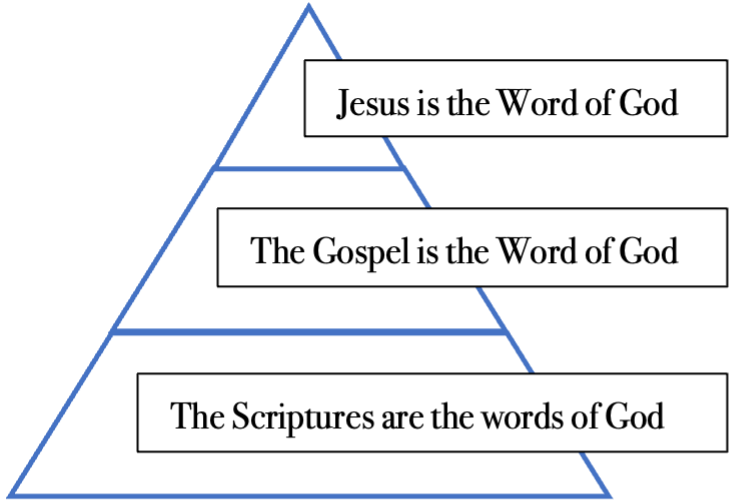
What this diagram is meant to illustrate is that ultimately, the exact expression of the Father is the Son. Jesus is the Word of God. He is the full communication of God’s mind to us, through whom we come to have communion with God. Moving down a level, the word (i.e. message) about Jesus is the gospel. The gospel tells us that Jesus is Lord. And finally, moving to the bottom of the triangle, the words contained in the bible – arranged in sentences and paragraphs and books etc. bring the gospel of the Lord Jesus to us. As we approach the scriptures, we must consider (at least) these three levels if we are to clearly understand the mind of God. Jesus controls our exegesis of every word in scripture, and every word in scripture controls our understanding of who the real Jesus is.
But to return to our original question then: what is the difference between “translating” and “explaining” or preaching God’s word? God ordained that his exact, infallible words would be written down by Prophets and Apostles. These words were then copied by fallible Scribes, translated by fallible Scholars, and preached by fallible Evangelists and Pastor-Teachers. This means of course that we cannot trust everything our Pastors say, or our translations, or even every manuscript we have. There is no point encouraging a false confidence in these things – as some have attempted to do by making grand claims, for instance, about the LXX or the KJV or other translations as if God’s sovereignty has specially protected the perfection of these translations.
Instead, we need to encourage each other to understand this process and to listen to the inerrant, infallible word of God through the fallible preachers and translations we have in front of us. For be assured, it can still be clearly heard at every level – Jesus was and is with us (John 1:18), he is Lord (John 20:28), the kind of Lord who once healed a blind man (John 9:7). Moreover, this ‘messy’ process is not bad news. Rather, it is part of the good news that God includes and involves us in bringing his revelation to the world. We get to participate in bringing the truth about God to every tribe and tongue – even though our tongues are flawed and feeble.
In order to give the sense, different kinds of translations are required. Some allow us to go into the details and nuances of the exact original words. Others help us understand the context and flow of the passage better. As an example, how might we translate the phrase κύριον Ἰησοῦν⸃ in Romans 10:9. Most english translations go for “Jesus is Lord”, but other possible translations might communicate the meaning more fully. Given the reference to Joel 2 in v.13, perhaps “Jesus is Yahweh” would be a helpful translation, or “Jesus is the Lord”. And of course we could flesh out what Lord really means… “Jesus is the ruler of the Kingdom of God, the eternal sovereign of the universe, he bought you, he owns you, he is the dictator over your sex life and wallet.”
Oftentimes I will hear people call this kind of preaching “Application”. But it seems to me that application has become an unhelpful term for us. What most people mean by “Application” is that once the preacher has communicated the sense of God’s word, he must then add in his own additional comments about what the congregation are to do or think in response. This is not the role of the preacher. The bible does its own application. Take 1 Cor. 1 for example – what is the application of Paul’sexposéof worldly wisdom throughout the chapter – boast in the Lord (v.31). As a preacher, I am not trying to add in additional ‘applications’ on top of the text, I am simply trying to translate the full meaning of the text to my hearers.
[1] F. Charles Fensham, The Books of Ezra and Nehemiah, NICOT. Accordance electronic ed. (Grand Rapids: Eerdmans, 1982), 217-218. Emphasis Added. mᵉp̄ōrāš is the word translated “clearly” in the ESV, while wayyāḇinû (with the root bı̂n) is translated “understood”.
[2] It is worth noting that the word “interpreting” here does not mean “giving one’s perspective on the text” as the word is often used by postmodernists today. Rather, in the older sense, it simply meant “explaining the meaning of the text” according to what the author intended to communicate.

The Clarity of Scripture
One of the central tenets of evangelicalism is the authority of scripture. God is our ruler. He rules us by his word. His word is the final authority in all matters of faith and conduct. We must submit to his word. God always speaks the truth – he cannot lie, he knows everything, so his word can always be trusted.
Of course, this view of scripture has always been attacked. From the serpent in the garden, “You will not surely die!” to the contemporary unbeliever, “The bible is fool of errors!” However, for the most part, in evangelical circles these attacks have been fended off. J.I. Packer’s classic treatment of the subject in Fundamentalism and the Word of God (1958) comes to mind or more recently Timothy Ward’s book Words of Life (2012). In evangelical minds and churches these books seem to have made their mark.
However, it seems to me that while we have been vigorously defending the authority of God’s word, we have inadvertently let another insidious heresy creep into our churches. Namely, while affirming the authority of scripture, many of our people continue to deny its clarity. “Of course,” they say, “we would submit to God’s word in all matters (e.g. gender roles or what have you), it’s just that the scriptures are unclear about exactly what God requires of us.” Functionally, this guts the doctrine of scripture’s authority completely. God cannot rule us effectively if we cannot understand him.
To solve this problem, many go in search of an authoritative interpreter – someone who will explain God to us, clarify what he is trying to say. The Roman Catholic turns to the papacy, and to church tradition for clarity. Perhaps, in a culture obsessed with novelty and throwing off the shackles of the past this will become more and more attractive to some. Knowing that the Orthodox/Anglican/Catholic church has held to this or that interpretation for hundreds of years can be comforting when other interpretations seem to lack weight.
Many ‘evangelicals’ effectively do the same thing – turning to their favourite preacher to find the interpretation that most suits them. If your preacher doesn’t interpret the passage in the way you like then you can just dismiss it “That’s just his interpretation”, “This passage is highly controversial – there are many different views on it.”
In this view, preaching is not an authoritative message from God that the listeners must sit under, it is merely the thoughts & opinions of the preacher that the congregation can take or leave. In the digital age, this problem has become exacerbated by the rise of celebrity preachers. If your local pastor (who is of course very ordinary) doesn’t agree with one or more of your favourite leading lights, then he must be wrong. Functionally, we have turned Carson, Keller, Jensen, or Taylor into Popes.
For some, ironically, Calvin is the Pope. One’s interpretation of scripture must always be Reformed (with a capital R) or it cannot be right. Of course, this was never what the reformers wanted.
First, the reformers stood against the Papacy. Councils and Cardinals have erred and contradicted one another countless times. They are mere men, sinful, corrupt, and confused just like the rest of us. They cannot be trusted as reliable or authoritative interpreters no matter how scholarly or educated they claim to be, nor how long their errors persist, nor how widespread or popular their views become.
Second, the reformers stood against the Anabaptists and the so-called “Right to Private Judgement”. This effectively multiplies the number of Popes. I have my interpretation; you have yours and we must leave it at that. Because the Holy Spirit is illuminating me from the inside, I can be confident of my interpretation no matter how scholarly those who disagree with me, no matter how novel my interpretation is, no matter how unpopular it is.
Of course, many Christians today see no alternative to these two positions. Left, apparently, with no options but these equal and opposite errors they end up drifting between the two, seeking some middle ground. Thankfully, the magisterial reformers (Luther, Calvin etc.) fell into no such trap because they rejected the basic premise – that the scriptures are unclear. And perhaps more than ever we must recover this confidence in our churches.
The doctrine of the clarity (or perspicuity) of scripture reminds us that the bible is not obscure or confusing, we are. It is we who are in the dark – lost in a sea of confusion created by our own sinfulness and the sinfulness of everyone we know. Our only hope is that by God’s grace the clear light of scripture will break through into our sinful minds and illumine us to the truth. Praise the Lord, “The unfolding of your words gives light” Psalm 119:130 (see also 2 Cor. 4:6).We do not have the right to interpret scripture. It is the height of blasphemy to imagine that human interpreters can communicate clearly while God cannot. No, “Scripture interprets Scripture”. The preacher does not step into the pulpit to clarify the bible, but to preach the clear word. The congregation does not seek their own interpretation of a passage, but humbly submits to the word they have heard.

The God Who Is There
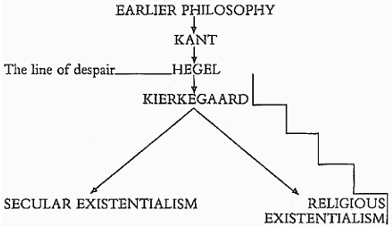
Francis A. Schaeffer (1912-1984) is often considered one of the four most influential evangelicals of the 20th Century along with Billy Graham (the Evangelist), John Stott (the Bible Teacher), and J.I. Packer (the Theologian). He was an American evangelist-theologian-philosopher-pastor-apologist and co-founder of the L'Abri community in Switzerland with his wife Edith. In 1968 he published a book called The God Who Is There. In this month’s edition of The Unichurch Papers I would like to briefly sketch his main thesis in the book just by way of introducing you to some of his insights.
The book revolves around what Schaeffer calls “the line of despair”. Above the line people believe in absolutes - absolute truth, morality and so on - and in the possibility of discovering those absolutes by careful reasoning. Below the line people have given up on the idea of absolutes, or at least the idea that we could ever come to know what they are through human reason. Throughout the book, Schaeffer traces the descent of western culture below the line. It all starts with humanism or rationalism:
“Humanism in the larger, more inclusive sense is the system whereby men and women, beginning absolutely by themselves, try rationally to build out from themselves, having only Man as their integration point, to find all knowledge, meaning and value.”[1]
“Above the line, people were rationalistic optimists. They believed they could begin with themselves and draw a circle which would encompass all thoughts of life and life itself without having to depart from the logic of antithesis. They thought that on their own, rationalistically, finite people could find a unity within the total diversity—an adequate explanation for the whole of reality. This is where philosophy stood prior to our own era. The only real argument between these rationalistic optimists concerned what circle should be drawn. … But at a certain point this attempt to spin out a unified optimistic humanism came to an end…
In the end the philosophers came to the realization that they could not find this unified rationalistic circle and so, departing from the classical methodology of antithesis, they shifted the concept of truth, and modern man was born. In this way modern man moved under the line of despair.”[2]
Having begun with philosophy, Schaeffer moves onto explain how art, music, “general culture”, and eventually theology all shifted below the line of despair. He traces the connections between Hegel, Kierkegaard, Picasso, the Beatles, Karl Barth and so on, slowly building up a series of diagrams.
Schaeffer describes Hegel as “the man to open the door into the line of despair” – though he himself did not move below it. Hegel suggested that instead of approaching truth on the basis of antithesis (i.e. the idea that if this is right, that must be wrong etc.), truth was to be discovered through synthesis (finding a rational compromise between two opposing positions). Schaeffer writes, “the conclusion is that all possible positions are relativized”.[3]
Kierkegaard is “the first man below” the line because he concluded, “that you could not arrive at synthesis by reason. Instead, you achieve everything of real importance by a leap of faith.” This, of course, is completely different to the bible’s definition of faith. In the bible, faith is not an irrational leap into the dark – or at least it shouldn’t be. The bible encourages us to put our trust in God because he is demonstrably trustworthy. In fact, to refuse to believe in such a God is irrational.
To conclude: it strikes me that in fact modern man is not so modern after all. Schaeffer’s definition of humanism would fit quite neatly as the bible’s definition of Sin. This is what Adam & Eve wanted when they ate from the fruit of the tree of the knowledge of good and evil. They wanted to know good and evil “beginning absolutely by themselves” rather than listening to God and trusting him. What modern man likes to call the enlightenment, was really just another expression of sin: “For although they knew God, they did not honour him as God or give thanks to him, but they became futile in their thinking, and their foolish hearts were darkened. Claiming to be wise, they became fools."(Romans 1:21-22) The only hope for our friends and colleagues to find true enlightenment is, of course, the gospel!
[1] Schaeffer, Francis A.. The God Who Is There (The IVP Signature Collection) (p. 25). InterVarsity Press. Kindle Edition.
[2] ibid. pp.26-27.
[3] ibid. p.30.

Evangelism Friendship
Friendship Evangelism (FE) is the idea that before you can share the gospel with someone 1
you need to establish a ‘meaningful’ friendship with them. It’s worth taking a careful look at this definition, because notice it is not the same as Friendly Evangelism, nor in fact is it about evangelising your friends, or becoming friends with people as you evangelise them. No - it’s actually a negative statement about the fact that you can’t or shouldn’t evangelise people who aren’t your friends.
Friendship Evangelism (FE) is the idea that before you can share the gospel with someone you need to establish a ‘meaningful’ friendship with them1. It’s worth taking a careful look at this definition, because notice it is not the same as Friendly Evangelism, nor in fact is it about evangelising your friends, or becoming friends with people as you evangelise them. No - it’s actually a negative statement about the fact that you can’t or shouldn’t evangelise people who aren’t your friends. Proponents of FE will say things like,
“You must ‘earn the right’ to share the gospel with people.”
Or, “Friendship evangelism is learning to build trustful relationships with unchurched persons in the context of secular life, and then listening and watching with patience and caring for situations in which they show openness for God.”2
Or, “Everything begins with coffee—including evangelism... And if we are good at listening and earn enough trust while talking about interests, eventually we’ll be ready to move the conversation to the next layer.”3
At first these statements might sound very intuitive and natural and good, but in the end we must reject FE for various reasons. Let me outline four.
First, FE flies in the face of the evangelistic methods used by Jesus and his apostles. For the most part they evangelised strangers – whether in private conversation (John 4) or in large crowds (John 6). There is not a single instance in the bible where we read of anyone holding off on evangelism until they have established a friendship. Paul did not arrive in Athens, settle down, take a couple of Athenians out for coffee to talk about the football, before attempting to breach the next layer of conversation. Moreover, the apostles don’t seem to have spent any time praying for specific people to be saved, instead they pray for boldness to share the gospel with everyone (Acts 4:29).
Secondly, it downplays the supernatural realities involved in evangelism – both the blindness of our unbelieving friends and the power of the gospel to enlighten strangers. Jesus expects family members to turn on those who believe his gospel (Matthew 10:34-39) rather than to respect them and find their new beliefs ‘more plausible’ because of their close relationship. Jesus’ own family certainly didn’t (Mark 3:21, John 7:5). In 2 Corinthians 4, Paul explains how and why evangelism is effective (or not), and it has nothing to do with the level of friendship established by the evangelist. It comes down to the fact that “the god of this world (aka the Devil) has blinded the minds of the unbelievers, to keep them from seeing the light of the gospel of the glory of Christ” but that in the case of his elect, God does a work of new creation in their hearts akin to when he said “Let light shine out of darkness” in the beginning!
Thirdly, FE disincentivises evangelism. After all, how many meaningful relationships can one really expect to establish and maintain – 3, maybe 4? If all your friends become Christians, you’ll either have to stop evangelising, or cut a friend to make space for more!
And finally, FE is not real friendship. Reflecting on church, Broughton Knox writes, “Personal fellowship is an end in itself, not merely a means to some other objective, and is a good thing in its own right. In fact, it is very distasteful when people, under cover of friendship and fellowship, have some other ulterior objective which they are driving at and hope to attain, so that for this purpose they cultivate a friendship or fellowship. We instinctively recognize the obnoxiousness of this use of fellowship.”4 This is no less the case when the goal we are driving at is evangelism. We ought to be upfront and honest about our motives and methods.
To summarise then, the problem with FE is that in the end it destroys both Friendship and Evangelism. Because it gets Friendship and Evangelism the wrong way around. True friendship does not aim at evangelism; evangelism aims at friendship – friendship with God and with his people. Instead of FE then, perhaps what we really need is EF - Evangelism Friendship! Evangelism that is friendly of course – because we long for people to become our friends. Evangelism that adorns the message we preach with loving and kind behaviour – like taking people out for coffee or inviting them over for dinner. Evangelism that is earnest and sincere from the very beginning. Evangelism that is hopeful – that recognises that any of our relationships - with our classmates, teammates, neighbours, could become true and eternal friendships by the power of the gospel.
1 https://www.gotquestions.org/friendship-evangelism.html
2 Sahlin, Monte. Ministry: International Journal for Pastors. September 1993.
3 Chan, Sam. How to Talk about Jesus (Without Being That Guy) (p. 37). Zondervan. Kindle Edition.
4 Knox, D. Broughton. Selected Works Volume II, Church and Ministry. Ed. Kirsten Birkett. 247.

James Bond Evangelism
Let me begin with a classic James Bond scene. It’s from Goldfinger. You might know it. Bond is strapped to a table, with a laser pointed between his legs that is slowly moving higher and higher. Bond says, “Do you expect me to talk?!” And Goldfinger responds with a maniacal chuckle, “No Mr Bond, I expect you to die.”
Well, as we’ve been working our way through Colossians, it struck me that, in a way, we’re saying the same thing to people whenever we share the gospel with them.

Used-Car Salesman Evangelism
Just what is a used-car salesmen supposed to do when he gets stuck with a lemon? The poor man - you have to feel for him. The engine rattles, the tyres are worn out, the suspension’s shot, but somehow he still has to sell it.
Just what is a used-car salesmen supposed to do when he gets stuck with a lemon? The poor man - you have to feel for him. The engine rattles, the tyres are worn out, the suspension’s shot, but somehow he still has to sell it.
So, of course, he focuses on the positives. He accentuates the attractive aspects of the car – the lights are in good working order, the paint’s a lovely colour etc. And he downplays the negatives. The things that won’t excite his clientele. He knows that many of his customers will make an emotional decision anyway – not a rational one. He simply has to turn on the charm, connect with them, and apply the right combination of humour and pressure to push through the sale.
In the short-term, it works. In the long-term, it has led to the stereotype about used-car salesmen that we all know - that they are insincere, dishonest and unreliable.
Unfortunately, some of our most popular evangelists seem to think that we should share the gospel like used-car salesmen. Apparently, the problem is that some important ‘gospel metaphors’ just don’t connect with our clientele anymore, “God as King, sin as rebellion, and salvation as submission” for example1. There was (apparently) a time when these ideas resonated “on college campuses in the 1980’s”2, but since then Australians have become much more resistant to authority figures. So, to be crass, presenting these aspects of our ‘product’ are just not going to persuade many of them to buy it anymore. Instead, we should focus on the more appealing metaphors like “peace with God... renewal and restoration of this world, especially by bringing Jesus’ love, mercy, justice, and beauty to this earth.”3
One problem with this approach (and there’s certainly more than one) is that ultimately it makes the gospel less believable. When we handle the gospel like a used-car salesman – carefully managing what we obscure or highlight to our listeners – we imply that our gospel is a lemon, and we undermine our own credibility as evangelists.
Instead, we ought to preach the gospel with boldness and enthusiasm - drawing people’s attention to any and every aspect of it. There is no aspect of the gospel we need be ashamed of (Romans 1:15-16), so there is no aspect of the gospel we should downplay. We must not give in to the used-car salesmen approach to evangelism. Even when our good news seems to be falling on deaf ears and veiled hearts, like Paul we must renounce “...disgraceful, underhanded ways. We refuse to practice cunning or to tamper with God’s word, but by the open statement of the truth we would commend ourselves to everyone’s conscience in the sight of God.” (2 Corinthians 4:1-2).
Notice that Paul does not just state the truth, he states it openly. The whole point is that the way he operates is transparent. There’s no trickery or cunning; no bait and switch, no strings attached, no fine print. Everyone knows what Paul’s about, and how he operates from the very beginning. Paul doesn’t hold off telling his listeners about the foolish cross (1 Corinthians 1:17ff) or the ridiculous resurrection (Acts 17:32) in the name of so-called ‘contextualisation’. And everyone knows he’s trying to convert them (Acts 26:28-29). We don’t trust used-car salesman, because we don’t trust people who just tell us what we want to hear. Likewise, why would we trust evangelists who craft their message to “scratch” where their listeners “itch”?4 Instead, we want evangelists who speak clearly and honestly about every aspect of the gospel – starting with the most important aspects, no matter how popular or unpopular these features might be.
And the declaration that “Jesus is Lord”, if I can put it like this, is the engine of the gospel. It is not just another gospel metaphor or aspect – it is not the leather seats or the sunroof. It is actually, when you boil it down, what makes the gospel the gospel. The fact that Australians don’t like authority figures is precisely why they need to hear this gospel and God’s command to repent. If we communicate, either explicitly or by omission, that people can find peace, renewal, love, mercy etc. when they come to Jesus, without submitting to him as Lord, we have not communicated the gospel, and we have lied. We have told Adam that he can keep living in the garden without God. No. Let us be up front and honest about what we’re doing and commend ourselves to people’s consciences. If our listeners don’t understand the value of our gospel – let us explain it to them. The Lordship, Rule, Kingship, Authority, Supremacy of Jesus is good news of great joy for all people!
1 Sam Chan, Evangelism in a Skeptical World, 86.
2 Ibid. 86.
3 Ibid. 99.
4 Ibid. 63. Cf. 2 Timothy 4:3.